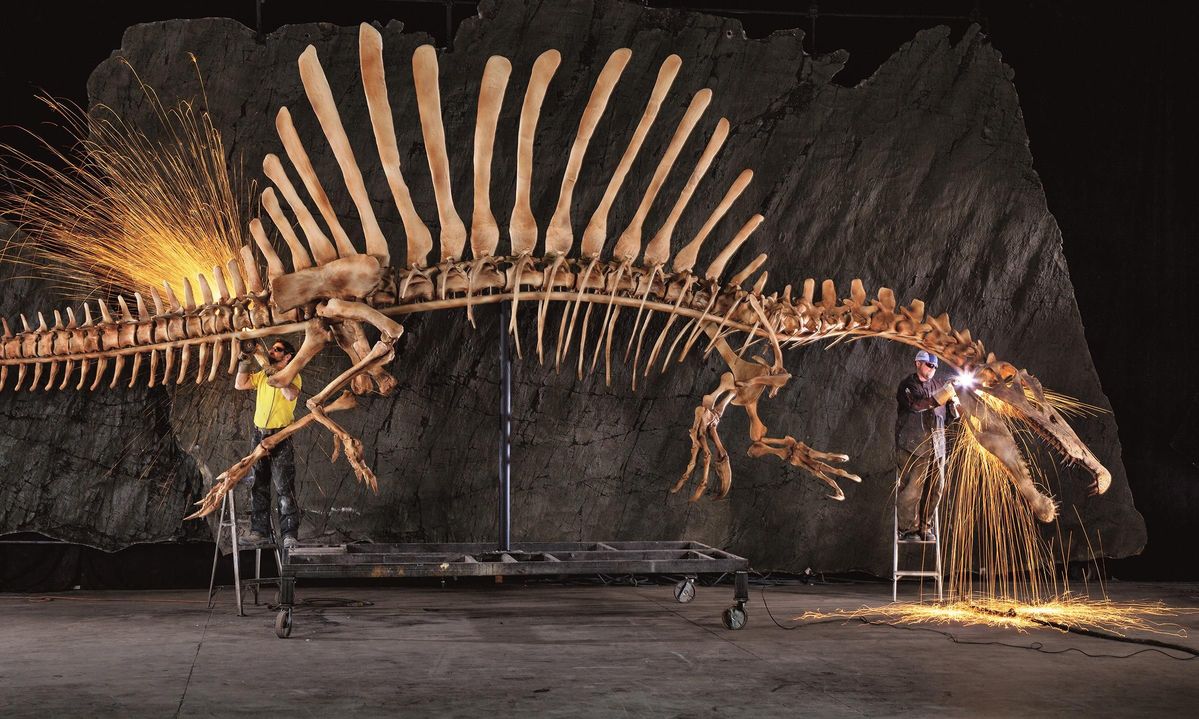
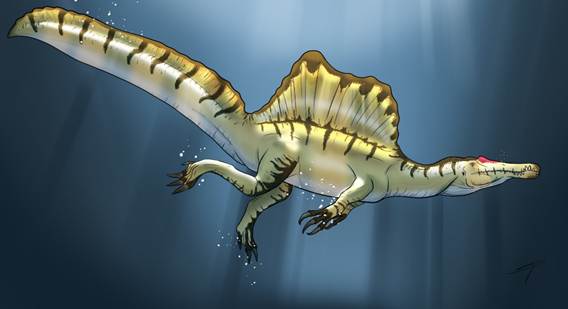
Image credit- Art by Thrasmodiel on Artstation
Description
Spinosaurus Aegyptiacus (not to be confused with Spinosaurus Mirabilis) lived 94-110 million years ago. This semi-aquatic theropod is well known for its almost rectangular sail of enormous size, with some sails having reached over 1.65 meters in height. This sail’s function is still being debated, although some plausible uses include:
- -Display for mating and courtship
- -Thermoregulation
- -Fat storage
Standing at an estimated height of 7.8 meters, Spinosaurus Aegyptiacus weighed 6-9 metric tons, and was 14-15 meters in length. This makes it one of the largest known theropod dinosaurs. As well as being considered one of the largest, it also has different limbs to other theropods.
Its hind limbs were rather short and connected to paddle-like feet.
These unique traits are due to Spinosaurus Aegyptiacus being semi-aquatic. (These traits have led some researchers to explore the idea of it being quadrupedal. However, the current belief is that this dinosaur was bipedal.) As well as limbs built to swim, its teeth were conical, straight and lacking in serration. This adaptation made it much easier to grip slippery prey (such as fish), suggesting Spinosaurus was mainly piscivorous. Although its diet mainly consisted of aquatic prey, it may have also occasionally fed on small dinosaurs/pterosaurs or carrion. Strong forelimbs and large claws could both have been used to scavenge and catch fish. The theropods skull measured 1.75 meters long, with a narrow and crocodile-like structure. Spinosaurus also had a paddle-like tail, which biochemical models suggest is unsuitable for high speed swimming, so experts theorise it was likely used to help with manoeuvring.
Habitat
Spinosaurus Aegyptiacus lived mainly in swampy habitats. It inhabited a region that is now part of North Africa, particularly in the Kem Kem Beds of Morocco and the Bahariya Formation of Egypt. During the late cretaceous this area was ideal for a semi aquatic creature such as the Spinosaurus, due to specific environmental elements. The region consisted of a large network of rivers and lush greenery, complete with swamps and shallow, slow-moving waters perfect for this predator. Fossils of Spinosaurus Aegyptiacus found alongside various marine fossils further supports the theory that it was a river dwelling species.
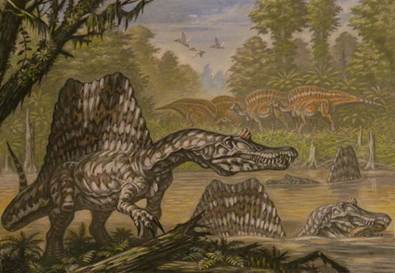
Image credit: ABelov2014 on DeviantArt
Discovery
In 1911, German paleontologist Ernst Stromer led an expedition to the unexplored deserts of Egypt, searching for mammal fossils. Stromer worked with Austrian fossil collector Richard Markgraf, as he had immense knowledge of the local area. Although they came looking for mammals, they instead found remains of several Cretaceous era dinosaurs. In 1912, Ernst Stromer returned to Germany while Markgraf continued excavating and discovered a partial skeleton of an unfamiliar dinosaur. Spinosaurus Aegyptiacus.
Markgraf shipped the new dinosaur to Stromer for study, where it was formally described as Spinosaurus Aegyptiacus, meaning “Spine Lizard of Egypt.” in 1915.
By 1936, as more and more fragments were found and sent to Ernst Stromer, he constructed the first full reconstruction. This model depicted Spinosaurus as a bipedal carnivore of enormous proportions, complete with a massive sail.
In 1944, the original fossils were unfortunately destroyed in World War 2 when the Munich Museum in which they were stored was bombed. For decades after this incident, Spinosaurus remained a mystery for over fifty years.
In 2008, a paleontologist known as Nizar Ibrahim was conducting field work in the Cretaceous Kem Kem Beds in Morocco when he acquired a small box containing unusual dinosaur bones. These fossils also had a unique cross section. A year later, Ibrahim was shown a partial dinosaur specimen from Morocco, which he recognized as a Spinosaurus fossil, similar to the one he had acquired in 2008. Four years later, he then returned to Morocco, tracked down the fossil dealer and found the original excavation site. After uncovering additional parts of the Spinosaurus specimen, Ibrahim and his team used digital measurements of their fossils and old photographs to conduct a full analysis. In 2014, they published the most accurate reconstruction of Spinosaurus Aegyptiacus so far, revealing its semi-aquatic nature.
In 2018, Ibrahim and his team returned to Morocco and unearthed an 80% complete juvenile Spinosaurus tail, which was previously missing from all specimens. The discovery allowed Ibrahim to further confirm that Spinosaurus Aegyptiacus was indeed semi-aquatic.
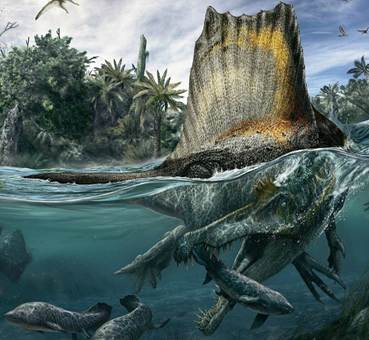
Image credit- National geographic
A unique species
Spinosaurus and its unusual adaptations revealed a lifestyle unique compared to any other known dinosaur. Its efficiency, strength, size, weight, skull structure and teeth all made it a ferocious predator that challenged traditional theropod behaviors. Although its sail’s use is still debated, it remains Spinosaurus Aegyptiacus ‘s most iconic trait. However, as new fossils are unearthed, our understanding of this strange dinosaur and how it played an important role in the late Cretaceous ecosystem continues to grow.
Sources:
Dinoanimals.com/dinosaurdatabase
www. fossilguy .com
www. Geologyin .com
scienceinsights.org
theropoddatabase
national geographic

Leave a Reply
You must be logged in to post a comment.