A black hole originates from a star far more massive than our Sun. Some stars weigh tens or even hundreds of times as much, and they produce energy through Nuclear Fusion in their cores. In the early stage of their lives, hydrogen nuclei fuse to form helium, releasing tremendous energy. This energy counteracts the inward pull of gravity, which keeps the star stable for millions of years. Eventually, however, the hydrogen in the core runs out. Without this fuel, gravity begins to dominate, causing the core to contract and heat up, allowing the fusion of helium. Helium starts fusing into heavier elements such as carbon, oxygen, and later into even heavier elements like neon and silicon. Over time, these processes produce a core made mostly of iron.
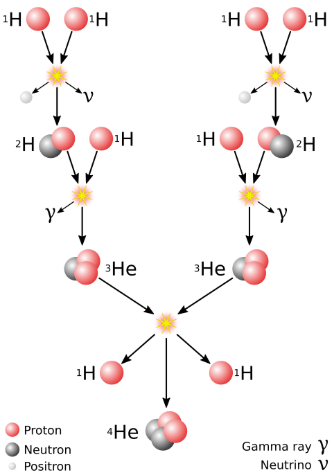
Iron is a turning point in the star’s life. Unlike other lighter elements like hydrogen, iron cannot release energy through nuclear fusion due to its most tightly bound atomic nucleus. Until this stage, nuclear fusion had provided pressure that balanced gravity. However, once the core becomes mostly iron, that support disappears, allowing gravity to force the core to collapse. In a matter of seconds, the core is compressed to extremely high densities and temperatures.
In some stars, this collapse halts and results in the formation of a neutron star—a compact object composed almost entirely of neutrons. However, in stars with sufficient mass, gravity is too strong to stop the collapse. The core continues shrinking until it crosses a critical threshold known as the Schwarzschild radius, which can be calculated using the formula:
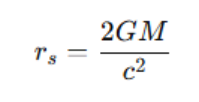
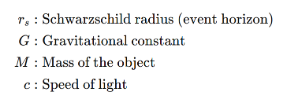
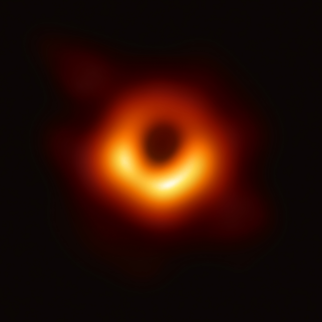
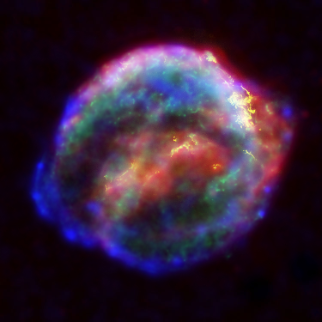
When a core collapses within this radius, the escape velocity exceeds the speed of light (nothing—not even light—can escape). An Event Horizon forms, marking the birth of a black hole. Meanwhile, the star’s outer layers may explode in a powerful Supernova, dispersing heavy elements into space and leaving behind the universe’s most mysterious object.
Sources
- “White Dwarf.” Wikipedia, 27 Feb. 2026, en.wikipedia.org/wiki/White_dwarf.
- “Nuclear Fusion.” Wikipedia, 3 Mar. 2026, en.wikipedia.org/wiki/Nuclear_fusion.
- “Stellar Nucleosynthesis.” Wikipedia, 12 Feb. 2026, en.wikipedia.org/wiki/Stellar_nucleosynthesis.

Leave a Reply
You must be logged in to post a comment.